
Explore Our Services

What We Offer
Water Quality Consultation
Every home is different, and your solution should reflect that. Before recommending any treatment, we always start with a consultation; because the right answer begins with knowing what's actually in your water. Each consultation package is all-inclusive: we handle the conversation, the testing, the lab, and the results review. By the time we're done, you'll know exactly what's in your water, what your options are, and what it would take to fix it. Whether you move forward with us, go another direction, or handle it yourself; you'll have everything you need to make that call with confidence.

What's Included in Every Package
A conversation about your home, water source, and any concerns you've noticed: taste, odor, discoloration, or health-related questions
Review of any existing test results you already have
Certified third-party lab testing at the tier you select
Results reviewed and explained by a water quality expert
A customized treatment recommendation built around your specific water and goals
A written summary and a clear plan of action you keep, no strings attached
-
Basic — $375
A reliable safety check covering the essentials. Tests for heavy metals, minerals, key inorganics, and core water quality indicators. A solid foundation for any homeowner, seeking to better understand their drinking water.
Tests: 53 parameters including lead, copper, arsenic, pH, hardness, nitrates, and more.
Best for: Annual monitoring, renters, and basic peace of mind.
-
Standard — $475
Our most popular package. Builds on Basic with a significantly broader chemical screen, giving you a thorough picture of your water's chemistry before you decide on next steps.
Tests: 113 parameters including everything in Basic plus VOCs, disinfection byproducts, and petroleum compounds
Best for: Home buyers, families, and health-conscious homeowners.
-
Comprehensive — $1,300
The most comprehensive water quality package we offer for our residential clients.
Tests: 136 contaminants. Everything in Standard, plus a PFAS panel and haloacetic acid (HAA9) screen tested to EPA 537.1 detection limits.
Best for: Maximum peace of mind, high-risk areas
Water Testing Only
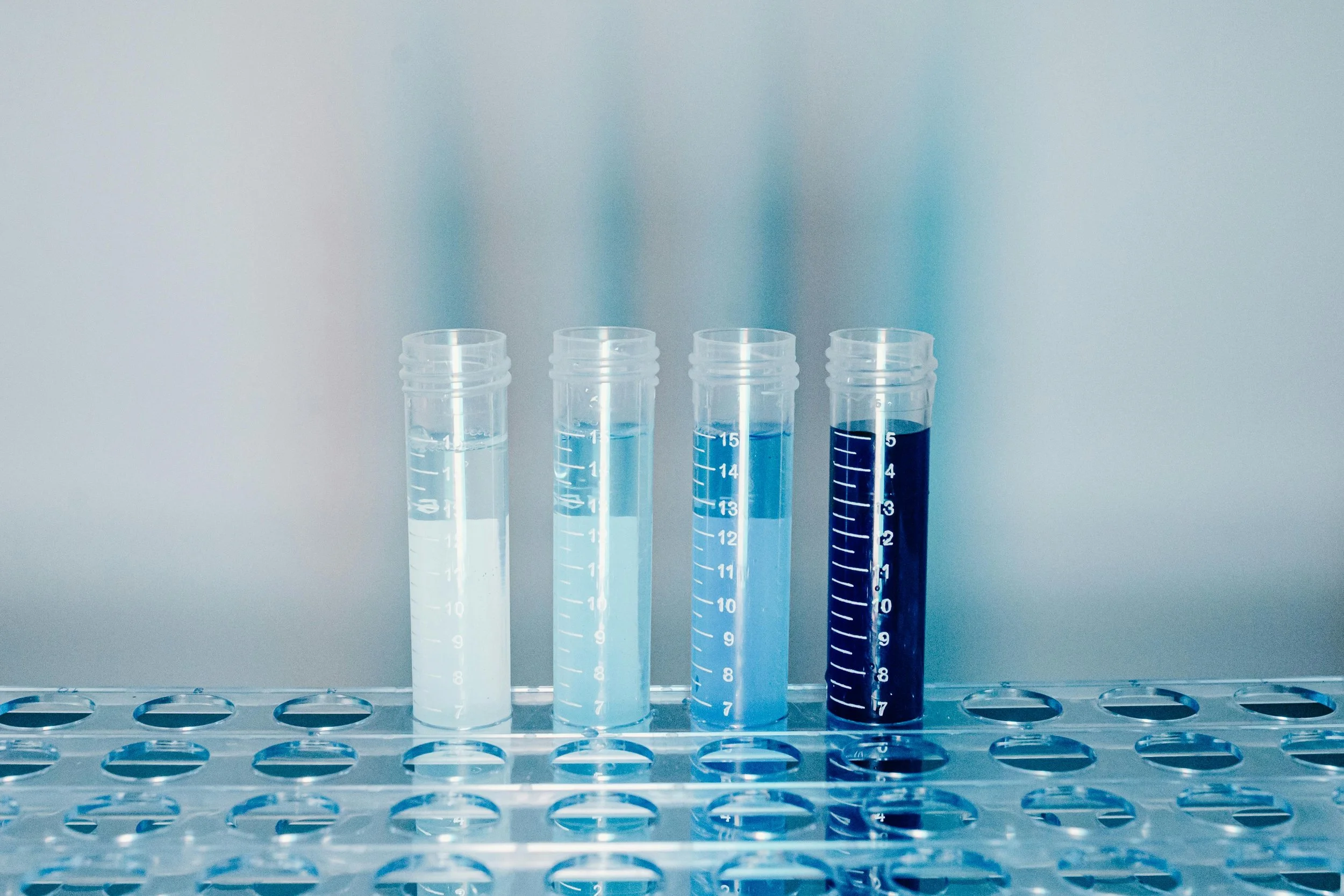
Sometimes you just want to know what's in your water; straight results, no consultation needed. We offer two ways to make that happen depending on how involved you want us to be.
Self Collection Testing We 2-day ship a sample collection kit straight to your door with prepaid 2-day return shipping and clear step-by-step instructions. You collect the sample, drop it back in the mail, and we handle it from there. You’ll get back a written summary explaining your results. Simple, affordable, and entirely on your schedule.
Assisted Testing Prefer to hand it off completely? We come to you. We handle sample collection at your home, shipment to the lab, and walk you through your results; what they mean, what's normal, and what's worth paying attention to. No consultation. Just accurate information delivered by someone who knows what they're looking at.
Either way, our standard panels are the same ones found in our complete consultation packages: Basic, Standard, and Comprehensive. Need something more specific? We can build a custom panel or add individual tests for whatever contaminants you have questions about.
No consultation. No commitment. Just your water, tested right.
-
Calculated Values: Bicarbonate, Carbonate, Chloride-to-Sulfate Mass Ratio, Grains per Gallon, Hardness (Ca, Mg), Hardness (Total), Langelier Saturation Index, Sodium Adsorption Ratio
Metals: Aluminum, Antimony, Arsenic, Barium, Beryllium, Cadmium, Chromium (Total), Cobalt, Copper, Iron, Lead, Lithium, Manganese, Mercury, Molybdenum, Nickel, Selenium, Silver, Strontium, Thallium, Tin, Titanium, Uranium, Vanadium, Zinc
Minerals: Calcium, Magnesium, Potassium, Sodium
Inorganics: Boron, Chloride, Fluoride, Nitrate (as N), Nitrite (as N), Phosphorus, Silica, Sulfate
Water Properties: Alkalinity (as CaCO3), Hardness, pH, Specific Conductivity, Total Dissolved Solids, Turbidity
Bacteria: E. coli, Total Coliform
Assisted Testing: $270
Self Collection: $215
-
Everything in Basic, plus:
Calculated Values: Total THMs
Volatile Organic Compounds (VOCs): 1,1 Dichloroethane, 1,1 Dichloroethylene, 1,1 Dichloropropene, 1,1,1 Trichloroethane, 1,1,1,2 Tetrachloroethane, 1,1,2 Trichloroethane, 1,1,2,2 Tetrachloroethane, 1,2 Dichlorobenzene, 1,2 Dichloroethane, 1,2 Dichloropropane, 1,2,3 Trichlorobenzene, 1,2,3 Trichloropropane, 1,2,4 Trichlorobenzene, 1,2,4 Trimethylbenzene, 1,3 Dichlorobenzene, 1,3 Dichloropropane, 1,3,5 Trimethylbenzene, 1,4 Dichlorobenzene, 2,2 Dichloropropane, Bromobenzene, Bromomethane, Carbon Tetrachloride, Chlorobenzene, Chloroethane, Chloromethane, Chlorotoluene 2, Chlorotoluene 4, cis 1,2 Dichloroethylene, Dibromochloropropane, Dichlorodifluoromethane, Dichloromethane, Ethylene Dibromide, Hexachlorobutadiene, Isopropylbenzene, n-Butylbenzene, n-Propylbenzene, p-Isopropyltoluene, sec-Butylbenzene, Styrene, tert-Butylbenzene, Tetrachloroethylene, Trichloroethylene, Trichlorofluoromethane, Vinyl Chloride
Disinfection Byproducts: Bromochloromethane, Bromodichloromethane, Bromoform, Chloroform, Dibromochloromethane, Dibromomethane
Petroleum Compounds: Benzene, Ethylbenzene, m,p-Xylene, Methyl Tertiary Butyl Ether (MTBE), Naphthalene, o-Xylene, Toluene
Pesticides: 1,3 Dichloropropene, trans-1,3 Dichloropropene
Assisted Testing: $375
Self Collection: $320
-
Everything in Standard, plus:
PFAS (EPA Method 537.1): N-Ethyl Perfluorooctanesulfonamidoacetic Acid, N-Methyl Perfluorooctanesulfonamidoacetic Acid, Perfluorobutanesulfonic Acid (PFBS), Perfluorodecanoic Acid (PFDA), Perfluorododecanoic Acid (PFDoA), Perfluoroheptanoic Acid (PFHpA), Perfluorohexanesulfonic Acid (PFHxS), Perfluorohexanoic Acid (PFHxA), Perfluorononanoic Acid (PFNA), Perfluorooctanesulfonic Acid (PFOS), Perfluorooctanoic Acid (PFOA), Perfluorotetradecanoic Acid (PFTA), Perfluorotridecanoic Acid (PFTrDA), Perfluoroundecanoic Acid (PFUnA)
Haloacetic Acids — HAA9 (EPA Method 552.2): Bromochloroacetic Acid, Bromodichloroacetic Acid, Chlorodibromoacetic Acid, Dibromoacetic Acid (DBA), Dichloroacetic Acid (DCA), Monobromoacetic Acid (MBA), Monochloroacetic Acid, Tribromoacetic Acid, Trichloroacetic Acid (TCA)
Assisted Testing: $1135
Self Collection: $1060
Water Filtration
Not all water problems are solved the same way, and not all filtration systems are created equal. The right setup for your home depends on a lot of moving parts: what's actually in your water, how much water your household moves through in a day, the physical space available for equipment, and how different filter media interact with each other in sequence. Get those variables wrong and you end up with a system that's either underperforming or working harder than it needs to, sometimes both.
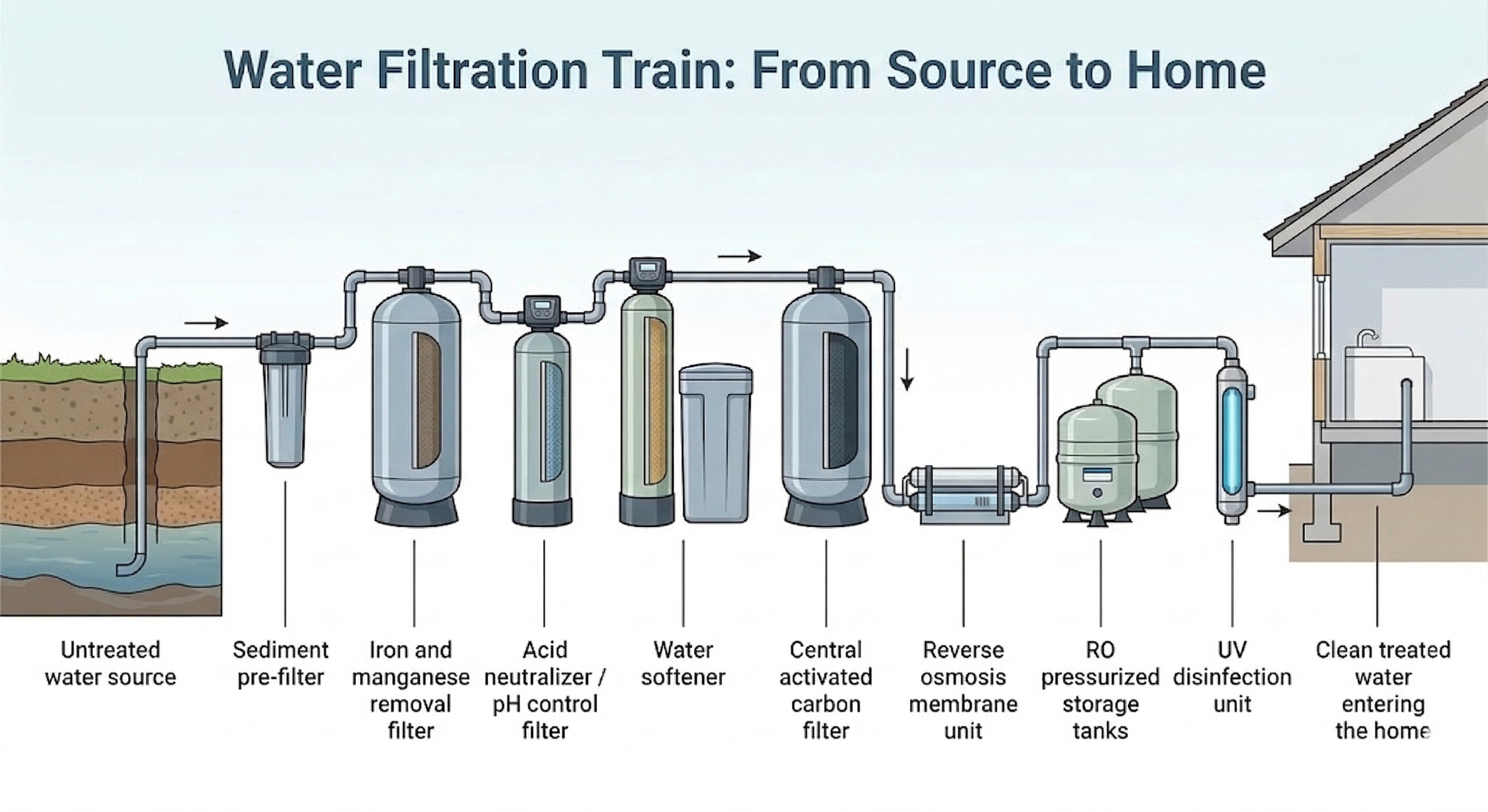
What we're building when we design a system for your home is called a filtration train; a series of filters arranged in a specific order, each one handling a different job. Think of it like a combine working a field. Every stage in that machine has a specific job, and they're arranged in a deliberate order for a reason. Skip a step, run them out of sequence, or size one wrong and the whole process suffers. A filtration train works the same way. The first stage might protect the ones behind it. The last stage might be the most sensitive. The order, the sizing, the flow rate, the contact time… it all matters. Change one thing and it affects everything downstream.
That's why we start with a consultation and a water test. There's no guessing, no one-size-fits-all package pulled off a shelf. Just a system designed around your water, your home, and how you actually use it.
Below is a breakdown of the filter types we work with and what each one does.
-
Sediment filtration is almost always the first stage of a whole-home filtration train, and for good reason. Before water reaches any of your specialty media or treatment stages, you want the large stuff gone : dirt, sand, rust, grit, and other suspended solids that would otherwise clog or degrade everything downstream. Think of it as protecting your investment before the real work begins.
Sediment filters come in a few forms. Standard cartridge-style sediment filters are the most common : affordable, widely available, and effective, though they require periodic cartridge replacement. Pleated filters offer more surface area and a longer service life than wound or spun cartridges. Spin-down filters take a different approach entirely, using centrifugal force to fling heavier particles into a flush chamber that you simply purge with a valve when it fills up : no cartridges, no disassembly. The clear chamber also gives you a real-time look at what's coming out of your water, which tends to surprise people who assumed their water was running clean.
Each option has its place depending on your water quality, flow rate requirements, and how much maintenance you want to deal with. Micron rating matters too : the lower the number, the finer the particles captured, and sizing it correctly for your home's flow rate keeps pressure drop from becoming a problem.
-
Cartridge filters are one of the most versatile tools in water treatment. The basic idea is simple: a replaceable filter element sits inside a housing, water passes through it, and contaminants get captured or adsorbed. What makes cartridge filters powerful is how many different problems they can solve depending on what's inside.
Activated carbon cartridges handle chlorine, taste, and odor. Catalytic carbon goes further, tackling chloramines and hydrogen sulfide. Specialty media cartridges can target iron, heavy metals, or even PFAS. Sub-micron carbon blocks push filtration down to the 0.5 micron range, capturing cysts and fine particulates that standard filters miss.
The housing is just the vessel, the cartridge inside is what does the work. That's why knowing what's actually in your water matters before choosing one. The right cartridge for your neighbor's house might do nothing for yours.
-
A multimedia filter utilizes a tank filled with stratified layers of naturally occurring or engineered filtration materials, to remove a broad spectrum of contaminants. This layered approach relies on varying densities and grain sizes to achieve deep-bed filtration. Typically, a combination of gravel, sand, garnet, and anthracite is used, with each material targeting specific particle sizes. Anthracite, being the least dense and having the largest particles, sits at the top to trap larger debris. Sand follows to catch mid-sized particles, while garnet ‘the densest material with the finest grains’ occupies the bottom layer to remove the smallest remaining suspended solids.
Unlike disposable cartridge filters, these systems are maintained through a backwashing and regeneration process. Backwashing involves reversing the water flow through the tank at a high velocity, which lifts and expands the media bed. This turbulent action shears off trapped particles and flushes them out through a drain line. Once the debris is cleared, the system performs a "rinse" cycle to resettle the media layers by density, ensuring the filter is regenerated and ready for continued high-volume service. This self-cleaning capability makes multimedia filters a low-maintenance, long-term solution for addressing iron, manganese, and general turbidity.
-
PFAS and PFOS are synthetic compounds that standard filtration isn't designed to catch, and require specific technologies proven to address them. The three main approaches are NSF/ANSI 58-certified reverse osmosis, NSF/ANSI 53-certified activated carbon block, and ion exchange resin media, each working through different mechanisms to capture these compounds as water passes through. Not all filters marketed for PFAS removal are created equal, and certification to NSF/ANSI standards for PFAS reduction specifically is the baseline for any verified removal claim.
It's also worth being upfront: no currently available technology removes 100% of PFAS compounds. RO and certified carbon block systems consistently achieve 90–99% reduction across most PFAS types, which represents the best performance available at the residential level. That's why proper water testing before and after installation matters; it's the only way to know what you're actually dealing with and confirm your system is performing as expected.
-
Reverse osmosis commonly referred to as RO forces water under pressure through a semi-permeable membrane with pores so small they block the vast majority of dissolved contaminants; heavy metals, nitrates, fluoride, chlorine byproducts, and more. The result is exceptionally clean water at the point of use, typically a dedicated faucet at the kitchen sink or a refrigerator line. RO systems produce a concentrate stream (reject water) that carries the filtered contaminants down the drain. They're considered one of the most thorough treatment technologies available for drinking water and are NSF/ANSI 58 certified for a wide range of reduction claims.
The tradeoff is efficiency. Traditional RO systems reject a significant volume of water in the process, commonly producing 3 to 4 gallons of wastewater for every 1 gallon of filtered drinking water, though higher-efficiency systems have improved that ratio. They also remove beneficial minerals along with contaminants which can leave the water tasting flat, and production rate is slow compared to standard flow.
Get In Touch
If you're interested in working with us, complete the form with a few details about your family and your water goals. We'll review your message and get back to you within 48 hours.